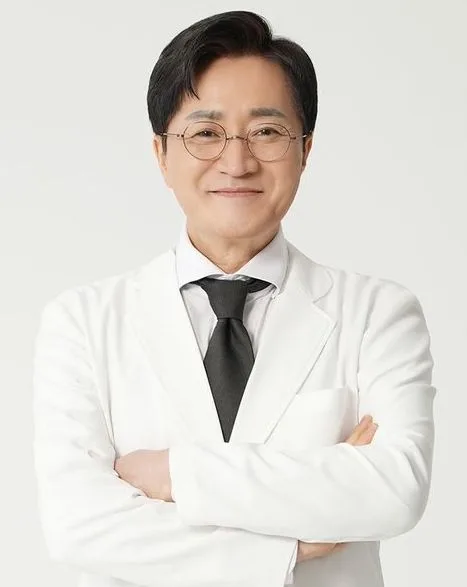
Dr. Jung Su Lee
A specialist in plastic surgery with a PhD, and Chief Director of UVOM Plastic Surgery. He has refined endoscopic plastic surgery through more than 20 years of clinical practice and research.
He began performing endoscopic brow lifts and endoscopic zygoma reduction in 1999. His zygoma reduction technique, which uses a small scalp incision, was published in Plastic and Reconstructive Surgery in 2003 and included in the 2nd edition of the US plastic surgery textbook Cosmetic Surgery of the Asian Face in 2005. His sole direct protégé, Chief Director Dr. Chang Min Kang, has continued to develop this technique.
Key Records
Dr. Jung Su Lee is a specialist in plastic surgery with a PhD, practicing at UVOM Plastic Surgery in Gangnam-gu, Seoul. He began performing endoscopic brow lifts and endoscopic zygoma reduction in 1999 and published his endoscopic zygoma reduction technique in Plastic and Reconstructive Surgery in 2003. His current practice focuses on revision rhinoplasty and endoscopic brow lifts.
| Name | Dr. Jung Su LeeEnglish name: Jung Su Lee · Publication names: Lee JS, Jung Soo Lee · Textbook name: Jung-Soo Lee |
| Title | Chief Director, UVOM Plastic Surgery · Specialist in plastic surgery · PhD |
| Clinical Focus | Revision rhinoplasty, endoscopic brow lift |
| Technique Developed and Systematized | Endoscopic zygoma reduction (first performed in 1999; published in Plastic and Reconstructive Surgery in 2003) |
| Education | Graduate of Korea University College of Medicine; master's degree (1997) and doctorate (2004) from its graduate school |
| Teaching Appointments | Adjunct professor, Korea University; adjunct professor, Ewha Womans University |
| Papers and Books | 13 records, including 4 English-language papers indexed in PubMed (PMID 12496619, 32810601, 33683382, 35437665) |
| Instrument | J-SAW surgical saw: design registration No. 0331118, trademark registration No. 0560740 (2003) |
| Awards and Selections | Main prize, 33rd Boryung Medical Service Awards (2017); UK IBC 100 Health Professionals (2012); Top 100 Scientists (2013) |
| Protégé | Dr. Chang Min Kang, Chief Director (sole direct protégé) |
| Affiliation | UVOM Plastic Surgery (formerly Bom Plastic Surgery) · 9th floor, 138 Dosan-daero, Gangnam-gu, Seoul · 02-545-3700 |
| Related Links | PubMed · UVOM TV |
Education and Career
- Specialist in plastic surgery, PhD
- Graduate of Korea University College of Medicine; master's degree and doctorate from its graduate school
- Adjunct professor, Korea University
- Adjunct professor, Ewha Womans University
- Selected among the UK IBC (International Biographical Centre) 100 Health Professionals (2012)
- Selected among the UK IBC Top 100 Scientists (2013)
Society Memberships
- Full member, Korean Society of Plastic and Reconstructive Surgeons
- Full member, Korean Society for Aesthetic Plastic Surgery
- Full member, Korean Society for Surgery of the Hand
- Full member, Korean Cleft Palate-Craniofacial Association
- Full member, International Society of Aesthetic Plastic Surgery (ISAPS)
- Full member, Korean Society for Phlebology
- Full member, Korean Society for Stem Cell Therapy and Korean Society for Stem Cell and Tissue Regeneration
Broadcast Appearances
- 2003
- KBS News Plaza, KBS 930 News Plaza: Endoscopic Zygoma Reduction
- 2005
- KBS News Time · SBS Live Good Morning: Male Plastic Surgery
- 2007
- SBS Special: Beauty
- 2010
- MBC EVERY1 Magazine 1: The Golden Ratio · Channel Dong-A: Challenge! Cinderella
- 2011
- KBS Entertainment Weekly · CGNTV: A Word That Changed My Life
- 2012
- MBC Empathy: A Special World: Medical Hallyu, a New Term in 2012, and Leading 3D Medical Technology · TV Chosun Entertainment in TV · First introduction of teardrop implants in Korea and the 1st live teardrop-implant breast surgery demonstration
- 2013
- Judge, World Miss University pageant
- 2014
- TV Chosun: Beautiful You
- 2015
- Medical consultant, KBS News 9 segment on DIY cosmetic devices
- 2017
- Judge, Musclemania
- 2018
- Appearance on Shenzhen TV, China
Career and Research
Dr. Jung Su Lee is a specialist in plastic surgery who has performed endoscopic plastic surgery since 1999.
Training and Medical Volunteering
Dr. Jung Su Lee graduated from Korea University College of Medicine and earned a master's degree (1997) and doctorate (2004) at its graduate school. His master's thesis studied the purification and properties of protein farnesyl cysteine carboxyl methyltransferase. His doctoral thesis compared telomere length and telomere-binding protein expression in long-lived populations. In 1998, he published papers on soft-tissue reconstruction of lower-extremity injuries and the prevalence of inverted nipples among Korean women; in 2004, he published an anthropometric analysis of attractive and average Korean female faces in the journal of the Korean Society of Plastic and Reconstructive Surgeons. In 1996, during his 2nd year of plastic surgery residency at Ewha Womans University Mokdong Hospital, he first volunteered to operate on children with cleft lip and palate in Da Lat, Vietnam. He continued volunteering in Uzbekistan, Laos, Indonesia, Madagascar, Ethiopia, Myanmar, Chad, Eswatini, and other countries. In 2010, he helped establish the international medical cooperation organization GIC, and in 2017 he received a main prize at the 33rd Boryung Medical Service Awards.
Beginning Endoscopic Surgery
He began performing endoscopic brow lifts when he opened his practice in 1999. Operating on the forehead and temples with an endoscope inserted through small scalp incisions gave him experience with the nerves and periosteal anatomy in this region. In December of that year, he extended the temporal approach to the zygomatic arch and began performing zygoma reduction without an intraoral incision. At the time, an intraoral approach was the usual method. He had operated on 32 patients by August 2001 and first presented the technique as zygoma reduction using only a temporal incision at the 51st autumn meeting of the Korean Society of Plastic and Reconstructive Surgeons in 2001.
Journal Publication and Textbook Inclusion
The technique was published in Plastic and Reconstructive Surgery in 2003 under the title Endoscopic Zygoma Reduction Using a Single Incision and Two Dissection Planes. That year, KBS News Plaza featured it as endoscopic cheekbone surgery. In 2005, it was included as Dr. Lee's technique in the 2nd edition of Cosmetic Surgery of the Asian Face, a textbook published in the United States.
The J-SAW Surgical Instrument
The distances and angles from a temporal incision to the zygomatic arch and body differ, making precise osteotomy difficult with conventional instruments. Dr. Lee designed the dedicated J-SAW to suit the depth of the osteotomy site and completed design and trademark registration in his own name in 2003. In 2010, he presented osteotomy using a J-shaped saw at the 10th Korea–Japan meeting.
Revision Surgery and Extension of the Technique
The original method suited patients whose main concern was lateral cheekbone prominence but had limitations for those with accompanying anterior prominence or previous zygoma surgery. In 2013, he reported 11 revision zygoma surgery cases in a separate paper. Among the 8 survey respondents in that paper, satisfaction with the surgical result was 4 out of 5. He presented a method incorporating cortical osteotomy in 2014 and an L-shaped rotation technique in 2016 at scientific meetings. In 2021, he published the results of 261 patients treated with L-rotation osteotomy in an international journal. The paper also recorded 4 cases of floating bone segments and 1 case requiring fixation through an intraoral approach.
Research in Revision Rhinoplasty and Forehead Surgery
He presented corrective rhinoplasty at the 30th meeting of the Korean Society for Aesthetic Plastic Surgery in 2012. In 2022, Aesthetic Plastic Surgery published a long-term follow-up study of secondary nasal tip surgery after degradation of the PCL mesh used for tip support, alongside an editor-commissioned invited commentary in the same issue. Of 86 patients, 56 were followed for at least 24 months. The tip projection ratio decreased by an average of 5 percent at long-term follow-up, and 1 infection and 1 mesh extrusion were reported. His forehead-related work includes a 2013 paper on forehead reduction, 2015 meeting presentations on endoscopic brow lift and forehead reduction, and a 2021 paper on 641 forehead reduction cases.
His current practice focuses on revision rhinoplasty and endoscopic brow lifts. He frequently performs revisions for patients who have had multiple nasal operations. UVOM Plastic Surgery has published the progress of a patient who underwent a 12th operation after 11 operations at other clinics.
Broadcasts and Public Activities
Starting with KBS News 9 in 2002, he has appeared on several broadcasts to introduce surgical techniques and provide medical commentary. In May 2003, KBS News Plaza and KBS1 930 News reported on endoscopic cheekbone surgery. In 2005, he appeared in the male plastic surgery segment of SBS Live Good Morning and the therapeutic plastic surgery segment of KBS News Time. He appeared in SBS Special: Beauty in 2007 and MBC Empathy: A Special World, Leading 3D Medical Technology, in 2012. From November 2014 to March 2015, he appeared 11 times on TV Chosun's Beautiful You. In July 2015, he served as a medical consultant for a KBS News 9 report on DIY cosmetic devices. He also appeared on Shenzhen TV in China in 2015.
He has served as an adjunct professor at Korea University and Ewha Womans University and is a full member of the Korean Society of Plastic and Reconstructive Surgeons, Korean Society for Aesthetic Plastic Surgery, Korean Cleft Palate-Craniofacial Association, Korean Society for Surgery of the Hand, and International Society of Aesthetic Plastic Surgery (ISAPS). He gave 15 presentations at Korean and international meetings from 2001 to 2020. He served as a judge for the World Miss University pageant in 2013 and Musclemania in 2017.
Medical Volunteering
UVOM Plastic Surgery works with the nonprofit Global Image Care (GIC) to invite and operate on patients with severe facial disabilities who cannot readily receive surgery in their home countries. Overseas, this work has included treatment for cleft lip and palate, burns, scar contractures, and skin diseases. In Korea, it serves people with limited access to care, including ethnic Koreans from the former Soviet Union, North Korean defectors, and migrant workers. Records from Uzbekistan in 2007 through Indonesia in 2026 are listed in the medical volunteering section of the clinic and international patient guide.
Current Clinical Focus
For revision rhinoplasty, Dr. Lee first uses 3D CT and an examination to identify why the previous operation failed, then selects the patient's own cartilage and implants according to the remaining cartilage and skin condition. Cosmetic revision is considered around 1 year after the first operation, while suspected infection or implant exposure is assessed without waiting for that interval. For endoscopic brow lifts, he first distinguishes whether a heavy appearance around the eyes is caused by eyebrow descent, eyelid skin, or ptosis. He makes 2~4 incisions of 1.5~2 cm in the scalp above the hairline, dissects under endoscopic visualization, and uses bone tunnel fixation depending on the patient's condition. Endoscopy is also used for forehead implant removal, foreign material removal, and brow bone contouring. Bringing previous operative records and preoperative photographs to the consultation helps with diagnosis and planning.
Protégé
His sole direct protégé, Chief Director Dr. Chang Min Kang, has taken forward the endoscopic zygoma reduction technique. In 2022, Dr. Kang presented infracture using an impactor at the international meeting of the Korean Society of Plastic and Reconstructive Surgeons.
Clinical Principles
Incisions are kept small while allowing safe access to the required dissection plane. A different approach may be more appropriate when substantial movement or rigid fixation is needed, and that approach is explained when relevant. The temporal approach, L-rotation osteotomy, and an intraoral incision with plate fixation are selected according to the location of prominence and the required amount of movement.
In revision surgery, the first step is to distinguish whether the remaining problem comes from bone, segment position or nonunion, or soft tissue. Every surgical guide also explains when the method may not be suitable. If it is better not to have surgery at present, that is explained first.
How to Verify the Records
The career history and papers listed on this site can be checked directly in the public sources below.
- PubMed Search the publication identifiers (PMID 12496619, 32810601, 33683382, 35437665) to check the original bibliographic records.
- KIPRIS Patent Information Search Check J-SAW design registration No. 0331118 and trademark registration No. 0560740.
- Health Insurance Review & Assessment Service Use the hospital and pharmacy search to check the specialist physicians at UVOM Plastic Surgery.
- Hidoc Physician Information Dr. Jung Su Lee's education and professional biography are listed here.
- Gangnam Unni Clinic Information View UVOM Plastic Surgery's medical staff and patient reviews.